
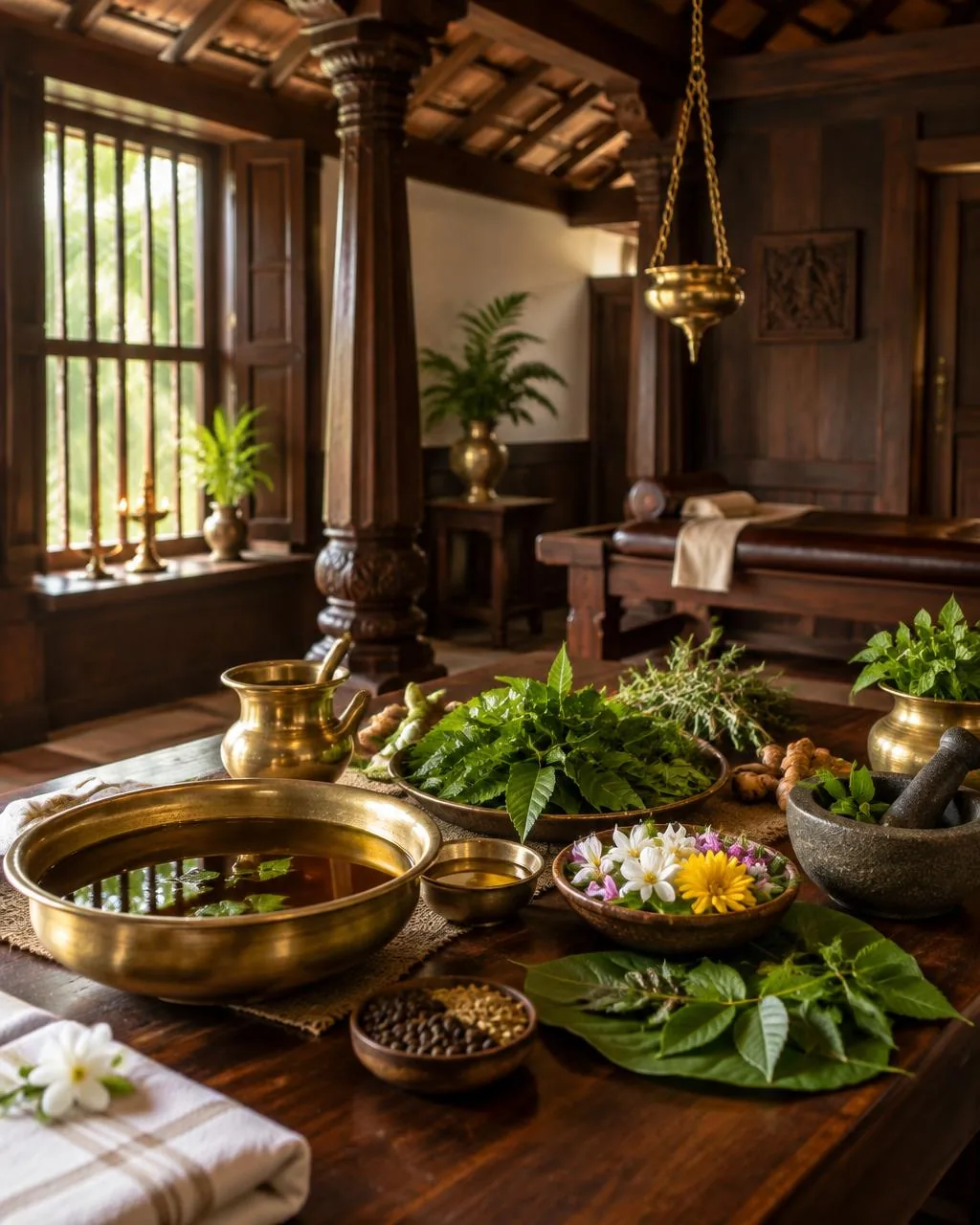
Ayurveda

The art of living well, practiced for generations.

Step beyond the spa menu and into a tradition that considers how you eat, rest, move and meet the world — all within the tropical stillness of Kerala.

The meaning of Ayurveda

An ancient science of life

Ayurveda originated in ancient India, with roots reaching back thousands of years. Its name comes from Sanskrit — ayus, meaning life, and veda, meaning knowledge or science. It is often translated as the science or knowledge of life.

That translation matters. Ayurveda is not only a collection of massages or herbal preparations. Traditionally, it is a broad system for thinking about everyday wellbeing: what you eat, when you rest, how you work, the season around you and the habits that shape your days.

Where modern routines often ask you to keep going, an Ayurvedic retreat invites you to notice. A morning can begin without a screen. A meal can be eaten without a meeting. A treatment can be followed by silence rather than the next appointment.

The luxury is not simply having something done for you. It is having the time, setting and knowledge to care for yourself well.

Kerala's distinctive Ayurvedic heritage

Ayurveda belongs to ancient India as a whole, but Kerala developed and preserved its own distinctive traditions. The region's tropical climate and extraordinary plant diversity supported a rich knowledge of medicinal herbs, while practitioner families kept classical learning alive through generations of change.

Central to this heritage are the Ashtavaidya, traditional practitioner families who passed Ayurvedic knowledge down through their lineages. Kerala also became known for particular oil-based practices and for immersive centres where food, routine, treatment and surroundings belong to one coherent experience.

References to practitioners and treatment settings describe the traditions you may encounter. Our retreat concepts are in development; individual venues and practitioners are not yet confirmed.

A traditional framework

The three doshas: a language of balance.

Classical Ayurveda uses three organising principles, or doshas, to describe combinations of qualities. Everyone is understood to have their own constitution; the language is nuanced, not a personality quiz.

Movement

Vata

Classical Ayurveda associates Vata with air and space, and with movement in the body and mind. Traditional discussions of balance may consider qualities such as lightness, mobility and change.

Transformation

Pitta

Pitta is associated with fire and water, and with transformation. In traditional teaching, it provides a framework for thinking about heat, digestion, intensity and purposeful activity.

Structure

Kapha

Kapha is associated with earth and water, and with structure and cohesion. Its traditional qualities include steadiness, nourishment and a sense of groundedness.

Doshas are traditional Ayurvedic concepts, not medical diagnoses. Online checklists cannot replace an individual consultation with an appropriately qualified practitioner.

Before any treatment

What a traditional consultation considers.

The personal nature of Ayurveda is part of its value. There is no thoughtful one-size-fits-all treatment menu, and no need for you to know the terminology before you arrive.

  1. 01

    Your everyday life comes first

    A traditional consultation may explore sleep, food, work, energy, routines and personal preferences. The aim is to understand the whole rhythm of your life rather than reduce you to a single concern.

  2. 02

    Tradition informs a personal approach

    Where professionally provided, a practitioner may use traditional observation and assessment methods to discuss your constitution and current sense of balance. These are Ayurvedic concepts, not a conventional medical diagnosis.

  3. 03

    Your retreat keeps room for choice

    Any suggested therapies, food approaches or routines should be explained clearly. You can ask questions, decline an experience and shape days that feel restorative rather than demanding.

Traditional treatments

Rituals of oil, warmth, touch and time.

These are practices you may learn about or encounter in Kerala, not a list of promised retreat inclusions. A practitioner should select and adapt any treatment for the individual.

Warm-oil massage

Abhyanga

Warm, herb-infused oil is applied with long, rhythmic strokes. More than a spa massage, Abhyanga sits within a wider traditional routine that values regularity, rest and care. The pace and unbroken rhythm make the experience feel deliberately unhurried.

A continuous stream of oil

Shirodhara

A gentle stream of warm oil flows across the forehead while you lie still. The simplicity of the ritual is part of its appeal: warmth, quiet and a pause from outside demands. It is offered only where an appropriately qualified practitioner considers it suitable.

Kerala's oil-pouring tradition

Pizhichil

Warm oil is poured over the body while therapists use coordinated, gentle strokes. Closely associated with Kerala's Ayurvedic traditions, Pizhichil is an elaborate ritual that requires a professional setting and individual assessment.

Warm herbal poultices

Kizhi

Small cloth bundles containing herbs, powders or other traditional ingredients are warmed and applied with measured movements. Different preparations have different classical uses, so the ingredients and approach should be chosen by a practitioner.

Traditional herbal steam

Swedana

A traditional warming or steaming practice that may follow certain oil therapies. The temperature, duration and suitability matter; it is not simply a sauna session and is not appropriate for everyone.

A structured classical programme

Panchakarma

Panchakarma refers to a group of traditional procedures described in classical texts, undertaken in a carefully supervised sequence. It is not a generic detox or a spa add-on, is not automatically included in our retreats, and requires assessment by qualified Ayurvedic physicians where appropriately offered.

Beyond the treatment room

Food, routine and the space between experiences

Traditional Ayurvedic living pays close attention to ahara, or food, and dinacharya, the rhythm of daily life. On an immersive retreat, that might mean fresh, thoughtfully prepared meals, regular mealtimes, gentle mornings and an evening routine that allows the day to close gradually.

The spaces between activities matter just as much. Rest after a treatment, reading in a shaded courtyard or simply watching rain move through the garden are not empty gaps in an itinerary. They are where an overstimulated schedule finally becomes a quieter one.

Why this can feel so different from a weekend spa break

A single treatment ends when you leave the room. An immersive retreat gives the whole day a gentler structure. You are not fitting a moment of calm around everything else; for once, everything else is allowed to fit around your rest.

A day shaped around you, not your inbox

An illustrative day might begin with gentle yoga and breakfast, continue with a consultation or professionally selected traditional treatment, then leave the afternoon open for sleep, a garden walk or nothing at all. Dinner, meditation and an early night replace the usual pull towards one more email.

You do not need to arrive exhausted, know your dosha or be good at switching off. Curiosity is enough. The experience is about giving yourself permission to step out of a life that constantly asks for more, and into a few days that ask much less.

This schedule is illustrative, not a confirmed itinerary. Ayurveda is a traditional wellness practice. It does not cure medical conditions, remove toxins or replace conventional medical care. Treatments can have contraindications; always discuss your health with your own doctor and disclose relevant information to the treating practitioner.

Time kept for yourself

You do not have to earn a slower pace.

Request an invitation and we will learn what rest means to you before shaping a bespoke Kerala retreat around your interests, budget and preferred pace.